
Access Control Infrastructure
RFID Access Control Systems for Secure Entry and Credential Programs
RFID access control systems connect identity credentials to physical environments, allowing organizations to manage who can enter buildings, spaces, and secured areas using contactless authentication.
As part of a broader credential program, RFID access control enables consistent, scalable, and secure entry management across facilities, campuses, and multi-location operations.
Access Within the Credential System
RFID Technology That Connects Identity to Entry
RFID access control allows credentials to work in real-world environments by linking identity data to secure entry points, adding a critical layer to a connected credential program.

System Role
Where RFID Access Control Fits
RFID access control is the layer that connects identity credentials to real-world access.
COMPATIBLE WITH:
- ID cards and credentials (identity layer)
- Secure printing (production layer)
- Fulfillment services (distribution layer)
- Credential management systems (program layer)
RFID cards are the physical credentials used for access, while access control systems determine how and where those credentials function.
Access Scenarios
How RFID Access Control Is Used
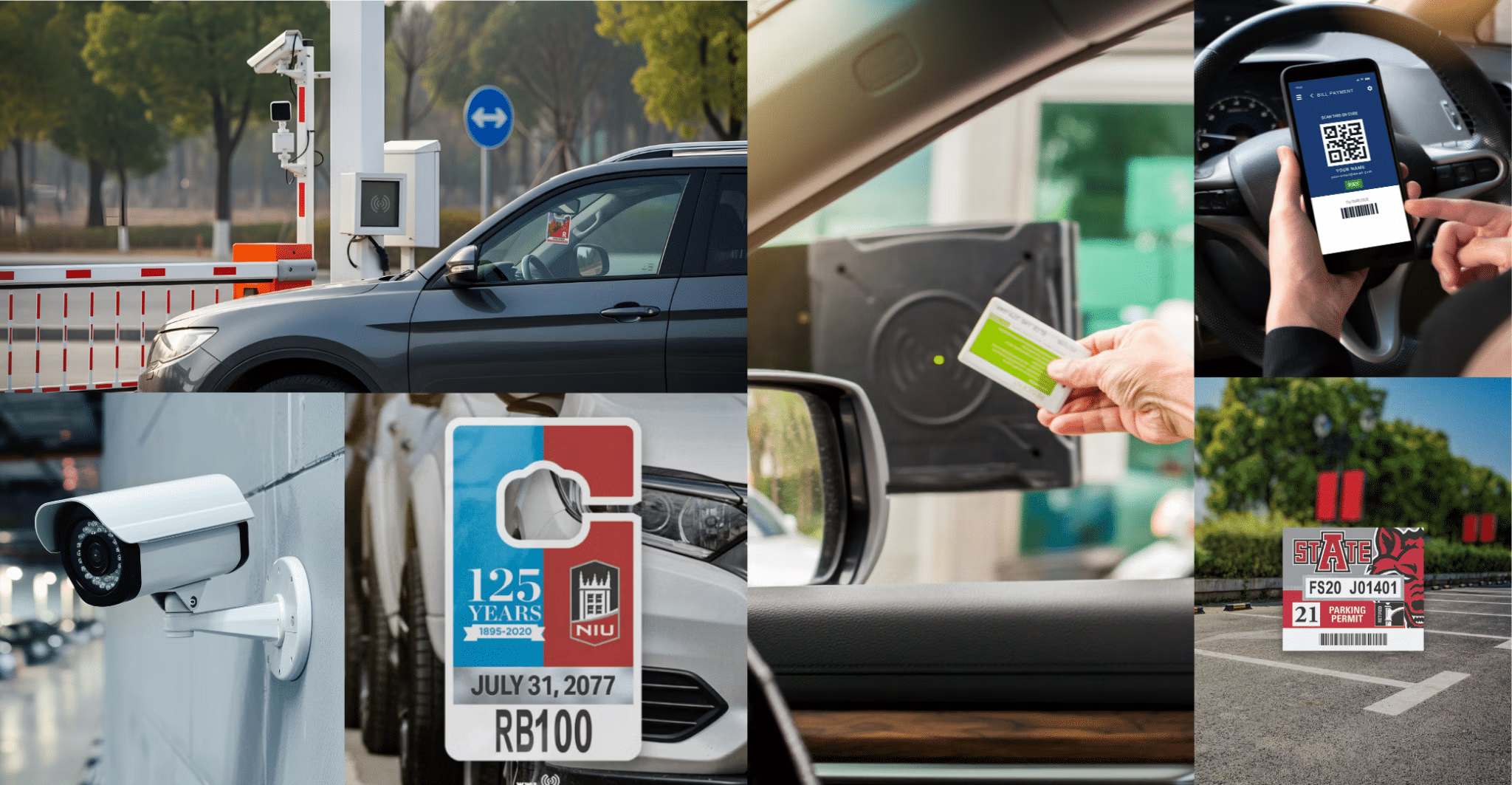
RFID access control supports a wide range of controlled environments:
- Building and facility entry
- Restricted areas (labs, offices, secure zones)
- Campus-wide access systems
- Employee and staff entry points
- Temporary or event-based access
These systems allow organizations to standardize access across locations and user types.

Credential Types
RFID Credential Options
RFID access systems support multiple credential formats:
- Contactless ID cards
- Key fobs and tokens
- Encoded badges
- Mobile-enabled credentials (where supported)
These credentials are encoded with data that interacts with access control systems.
System Integration
Integration with Existing Infrastructure
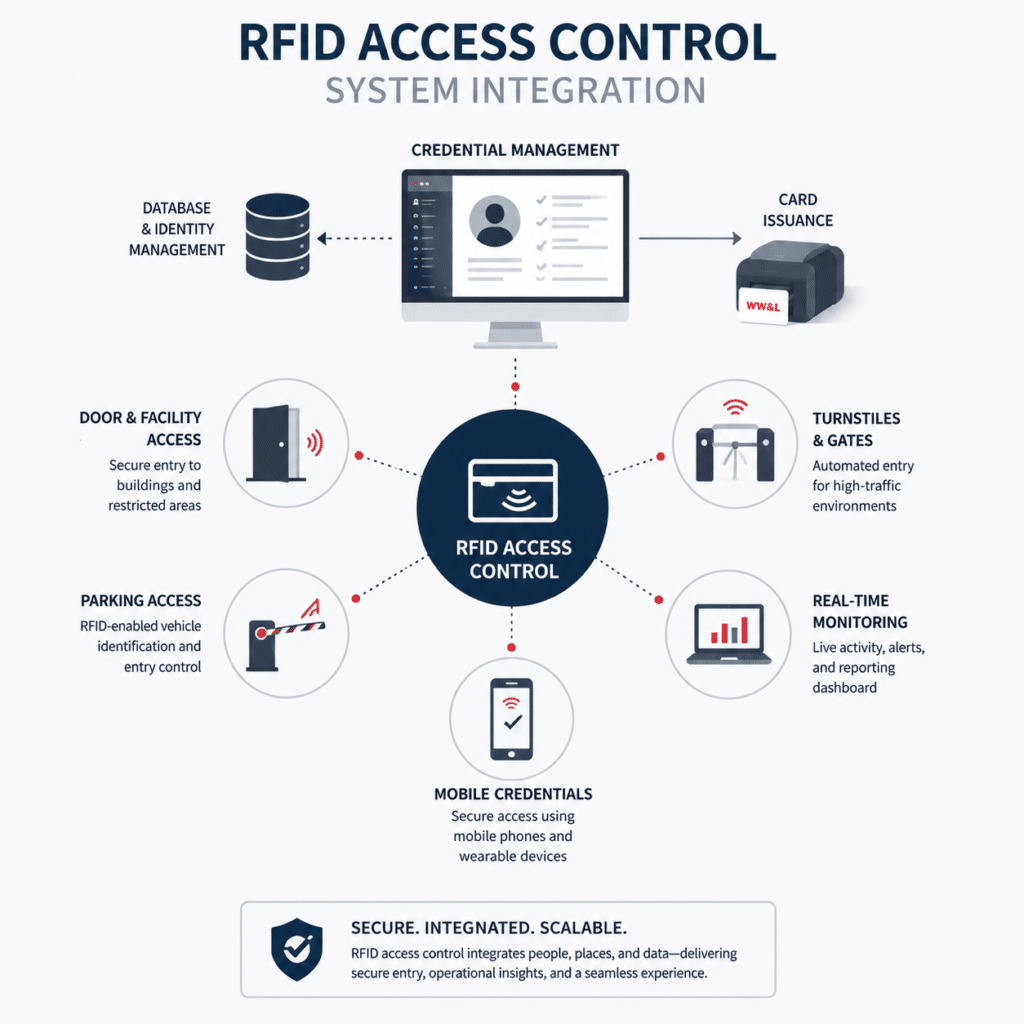
Access control systems connect with existing technologies across your organization.
They typically integrate with:
- Door readers and entry hardware
- Access control management platforms
- Identity databases (HR or student systems)
- Visitor management systems
- Parking and mobility systems
This allows credentials to function consistently across environments.

Security Controls
Secure and Controlled Access
RFID access control helps organizations manage and protect access to facilities.
It enables:
- Role-based access permissions
- Controlled entry to sensitive areas
- Reduced unauthorized access
- Centralized management of credentials
These systems support environments where security and access accuracy are critical.
Who Uses RFID Access Control
Environments and Use Cases
RFID access control systems are used in organizations that require structured entry management:
- Higher education campuses
- Healthcare facilities
- Corporate offices
- Government buildings
- Event venues


Connection to Credential Programs
Part of a Unified Credential System
RFID access control is most effective when implemented as part of a coordinated credential program.
This connects:
- Identity credentials
- Access systems
- Production workflows
- Fulfillment processes
into a single system that improves consistency, security, and scalability.
Operational Benefits
Why Organizations Move to RFID Access Control
Organizations implement RFID access control to improve how access is managed across people, facilities, and systems. Compared to manual or disconnected access methods, RFID-enabled systems provide:
- Faster and more consistent entry experiences
- Reduced administrative workload for issuing and managing credentials
- Improved control over who can access specific areas
- Fewer errors in credential assignment and usage
- Better visibility into access activity across locations
These improvements help organizations maintain secure environments while scaling operations more efficiently.
Frequently Asked Questions
RFID access control is a security system that uses radio frequency identification (RFID) credentials—such as cards, badges, or wristbands—to grant or restrict access to physical spaces. When a credential is presented to a reader, it verifies identity and unlocks doors, gates, or secured areas if authorized.
RFID systems work by embedding a small chip and antenna into a credential. When the credential is near a reader, the reader sends a radio signal that activates the chip. The system checks the credential ID against an access database and either grants or denies entry in real time.
Key benefits include:
• Faster, contactless entry
• Improved security and reduced unauthorized access
• Centralized access management
• Easy credential updates and deactivation
• Scalable across multiple facilities or campuses
Common RFID credentials include:
• ID badges and access cards
• Key fobs
• Wristbands (often used for events or healthcare)
• Mobile-enabled RFID credentials (in some hybrid systems)
Yes—when properly configured. RFID systems use encrypted identifiers and centralized access control software. Security is strengthened further through role-based permissions, audit logs, and multi-factor integrations when needed.
RFID is actually a type of keycard system, but more modern and flexible. Traditional magnetic stripe cards require physical swiping, while RFID uses wireless communication for faster, contactless access and better durability.
Yes. RFID access control can integrate with:
• Identity and credential management systems
• Time and attendance tracking
• Facility management platforms
• Visitor management systems
• Security and surveillance systems
Lost or stolen credentials can be instantly deactivated in the access control system. A replacement credential can then be issued without changing physical locks or compromising security.
Yes. RFID systems are scalable and can be implemented for small offices, schools, and organizations, as well as large enterprise or multi-campus environments.
RFID uses physical credentials like cards or fobs, while mobile access uses smartphones as credentials. Many modern systems support both, allowing organizations to transition gradually or support multiple access methods.
Yes. Most systems maintain detailed logs of who accessed which areas and when. This supports auditing, compliance, and security investigations.
Plan Your RFID Access Control System
If your organization is evaluating RFID access control, WW&L can help define how it fits into your credential program, access requirements, and operational workflows.